
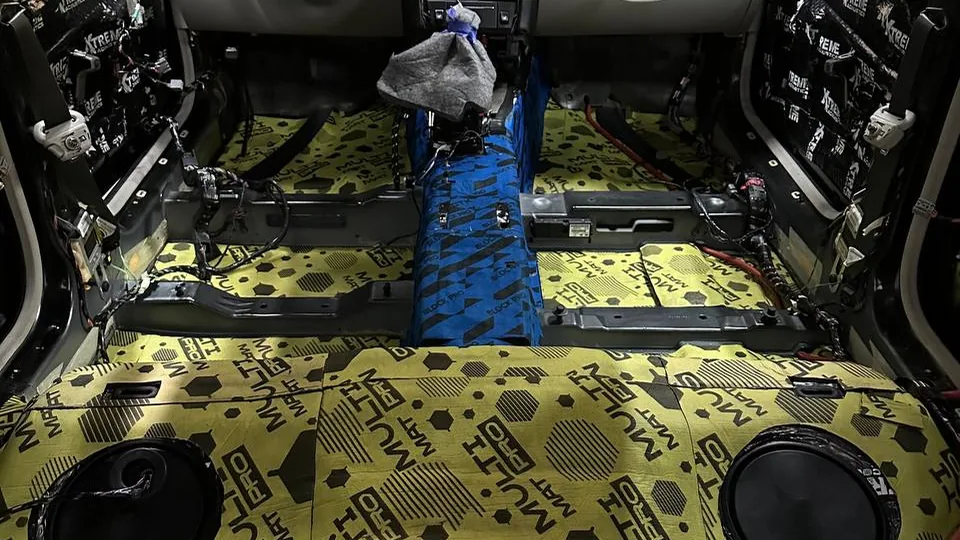
Choose car soundproofing layers based on the noise, how it reaches the cabin and the space available under the trim. A damping mat reduces panel vibration, an absorber takes up some sound energy and a heavy barrier reduces sound transmission. To estimate the added weight, multiply the installed area of each material by its weight in kg/m² and add the results.
What do damping mats, foams and sound barriers do?
When a metal panel booms, damping addresses the vibration of that panel. When road noise comes through the floor, the path into the cabin also matters. Products sold as soundproofing foam can serve different purposes. Check what the specific product is designed to do.
| Material | What it does | What to check before choosing it |
|---|---|---|
| Vibration damping mat, such as foil-faced butyl | Reduces vibration in the panel it is bonded to. | Suitable surfaces, surface preparation and application temperature. |
| Sound absorber, such as porous acoustic foam | Absorbs some sound energy and reduces reflections behind trim. | Whether the area is dry and protected if the product requires it. |
| Resilient closed-cell foam | Can separate a heavy barrier from a rigid surface or cushion contact between parts. | Whether the product is designed for that use and how much clearance is available. |
| Heavy sound barrier | Reduces sound transmission through the area it covers. | Continuous coverage, weight, support beneath the barrier and paths sound can take around it. |
How do you choose layers for doors and floors?
Treat the door cavity and the dry area behind the door trim as separate locations. Inside the cavity, account for water and keep the drains clear. Behind the trim, check clearance for foam and clips, and make sure the window can travel freely. If a loose fastener is rattling, fix it first.
Under the carpet, check clearance for the full stack and access to seat mounts and wiring. Consider a heavy barrier when the floor is a significant path for noise and the barrier can be fitted as specified. In areas exposed to water or heat, check the approved location, moisture resistance, installation temperature and operating temperature range. Thickness mainly tells you how much space the layer takes up. Compare performance for the same function under the same test conditions.
How much do two treatments for the same floor area weigh?
Suppose you are comparing two options for a 2 m² section of floor. Both use 1 m² of damping mat and 2 m² of foam. Option B adds a barrier over 2 m². The areas are illustrative. The weights come from the CTK Premium 2.2, Elastic 6 and BlockPro 2 product specifications. The foam and barrier figures are calculated by dividing net sheet weight by sheet area.
| Layer | Weight per m² | Option A | Option B |
|---|---|---|---|
| Damping mat | 3.07 kg/m² | 1 m² × 3.07 = 3.07 kg | 3.07 kg |
| Resilient foam | 0.50 kg/m² | 2 m² × 0.50 = 1.00 kg | 1.00 kg |
| Heavy barrier | about 3.22 kg/m² | 0 kg | 2 m² × (0.595 kg ÷ 0.185 m²) ≈ 6.43 kg |
| Total | 4.07 kg | about 10.50 kg |
How can you use the calculation to compare quotes?
In the example, the barrier adds about 6.43 kg. For your own estimate, ask for a separate line for each material and area. Use the total area of the pieces that will be fitted, including any overlaps. For a two-in-one product, count the weight of the whole sheet once. Round the figure after adding all the lines.
A quote line might read ‘boot floor / sound barrier / product name / coverage in m² / kg/m² / added kg’. Add any extra adhesive, tape or fasteners that will be fitted if their weight is still unaccounted for. The weight difference tells you how much mass you are adding. To judge the likely effect on noise, ask which area is covered and how sound reaches the cabin.
Questions and answers
What if the data sheet lists only the pack weight?
Look for the net weight of the material and the total area in the pack. Divide that weight by the area. Shipping weight includes the packaging. If the net figure is unavailable, ask the manufacturer or weigh a sample of known area after removing the release liner.
Does the weight of the mats I buy equal the weight added to the car?
Count only the material that stays in the car. Allow for offcuts when working out what to buy. Offcuts and release liners add nothing to the installed weight. If factory material is removed during the job, subtract its weight to estimate the net increase.
Can I check the added weight after installation?
You can weigh the car before and after using the same scale with the same equipment and load and a similar fuel level. For a small change, the scale may lack the required resolution. In that case, ask for a record of the materials fitted and any items removed during the job.
Plan car soundproofing in Warsaw
Note your car model, where and when you hear the noise and whether keeping the added weight low matters to you. Bring those details when discussing areas and materials.