
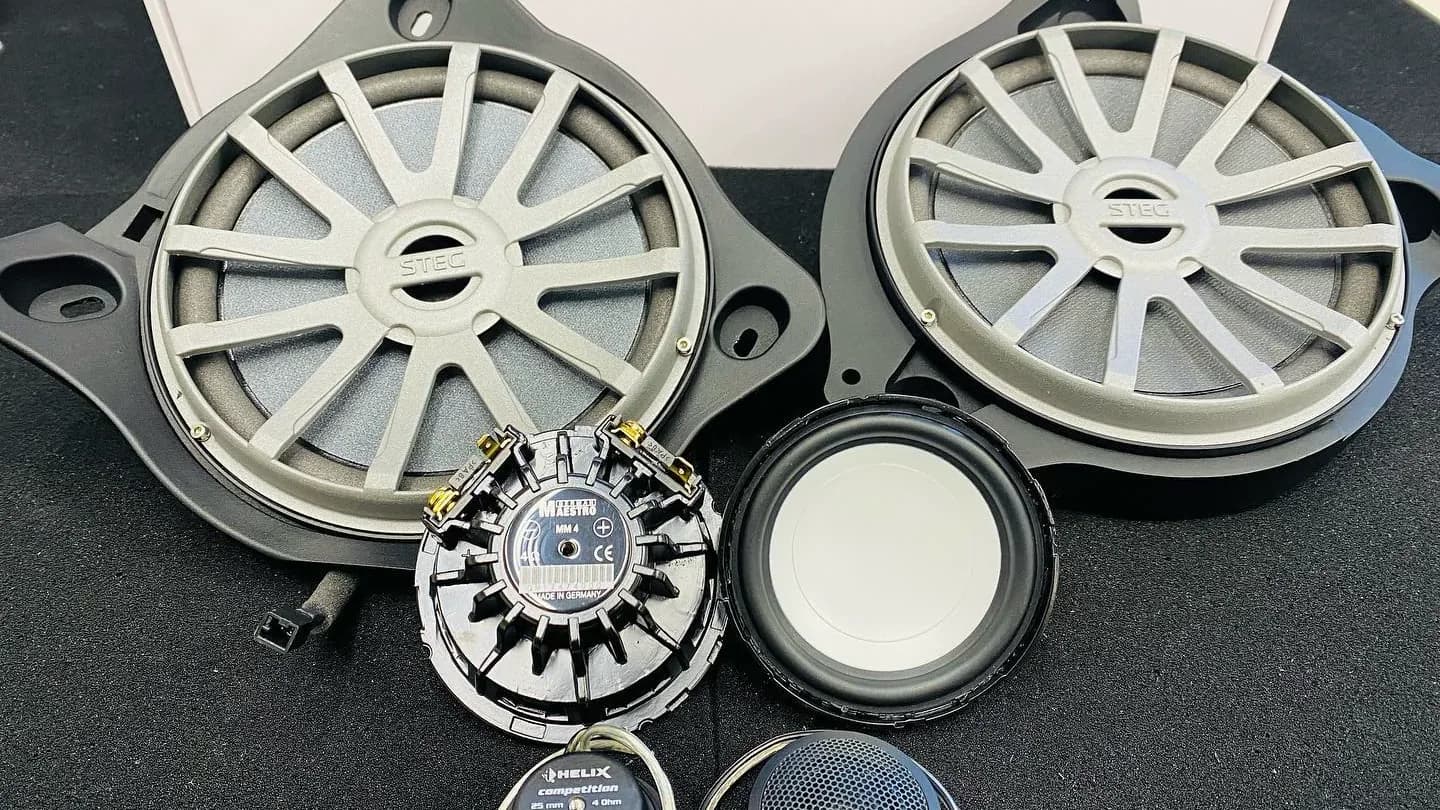
Replacing car speakers without adding an amplifier can make sense when you want different sound at moderate listening levels and the new set suits the vehicle electrically and physically. It does not increase the factory system’s amplifier power. Before buying, check impedance, sensitivity with its test conditions, the signal bandwidth and mounting requirements. A speaker swap alone cannot guarantee much louder playback or deep bass.
What does “without an amplifier” mean in a factory system?
Usually it means without an additional unit. The speakers still run from the head unit’s power stage or a separate factory amplifier. Identify the audio package first, rather than relying on the vehicle’s make and year alone. One vehicle model can have several different signal paths.
Write down one goal: clearer vocals, replacing a worn speaker or higher volume. The first two justify assessing a speaker swap on its own; the third also requires checking available amplifier headroom. These are different acceptance criteria, rather than a promise that everything will improve at once.
Impedance and sensitivity: compare the complete figures
Impedance describes the load presented to the amplifier. A load which is too low can strain an unsuitable amplifier. Do not choose 2 Ω instead of 4 Ω solely to get more volume. Compatibility must follow the documentation for the specific output and speaker set; a matching connector does not establish it.
Check the units alongside sensitivity. The Ci3 C165.2FM-S3, for example, is rated 92 dB at 2.83 V/1 m and 88 dB at 1 W/1 m. These describe the same model under different conditions, rather than conflicting figures or an in-car measurement. Comparing bare dB numbers from different data sheets is misleading.
Why does voltage matter? In a simplified calculation for a resistive load, P = U²/R: 2.83 V represents roughly 1 W into 8 Ω, 2 W into 4 Ω and 2.67 W into 3 Ω. A real speaker’s impedance varies with frequency. This example explains the units; it does not predict the loudness in your car.
A speaker’s wattage is not the head unit’s output
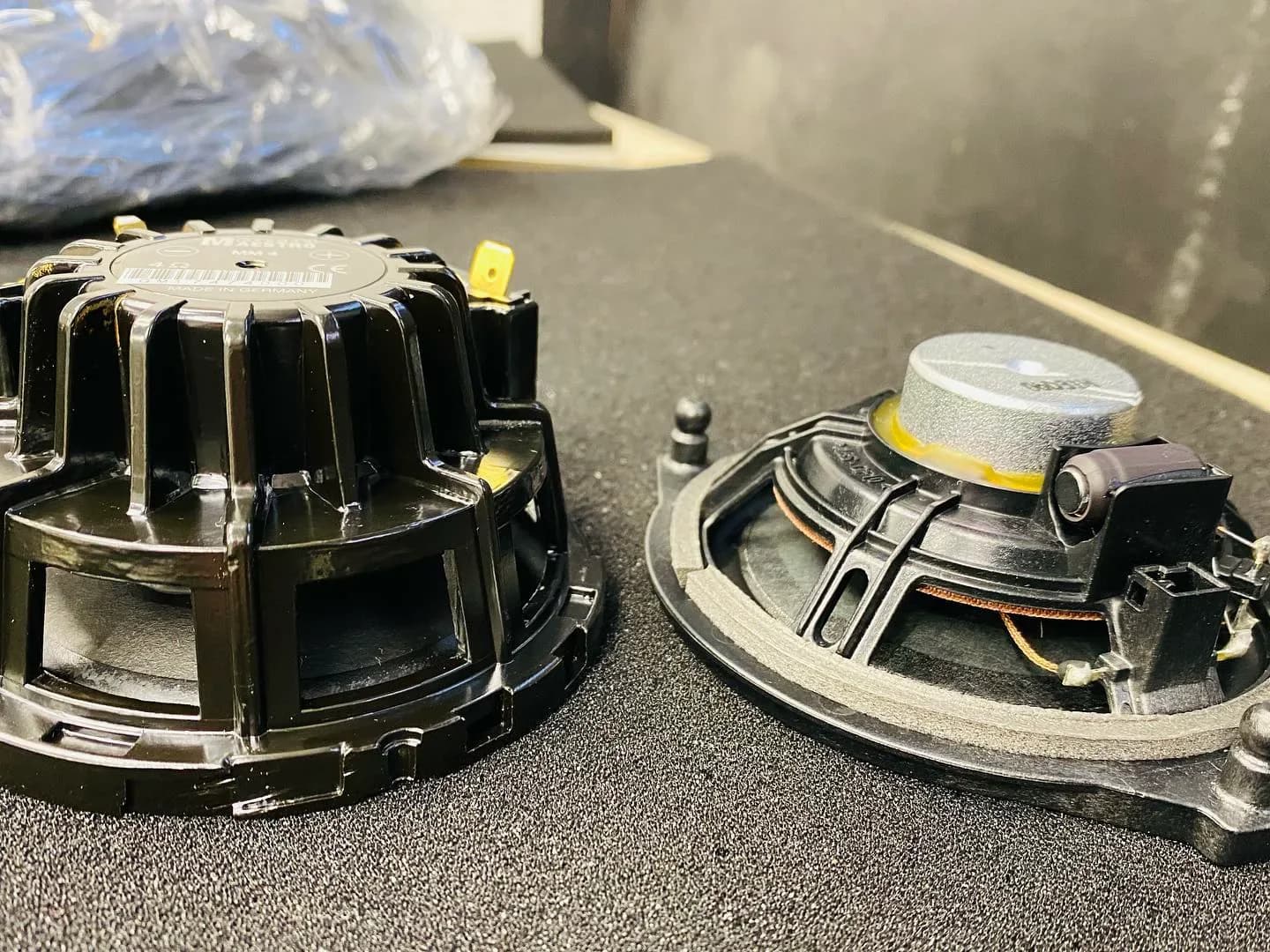
The Focal ISU 165 sheet separately lists 70 W RMS, 140 W maximum and sensitivity of 93 dB at 2.83 V/1 m. These are different specifications. A speaker’s rated power does not tell you what the radio will deliver or how loud the complete system will be. These figures illustrate how to read a data sheet, rather than recommending a product.
When comparing proposals, ask which problem the proposed set is meant to solve while retaining the current amplification. A larger wattage on the box does not answer that question. Nor should every factory head unit be assumed to have the same output power.
The signal and installation can limit the outcome
A replacement speaker cannot recover frequencies absent from its input. A factory channel may carry only part of the spectrum; establish this before replacing an individual driver with a coaxial set. Some kits (Focal ISU, for example) also place filters inside the connectors: an adapter is not always just a length of wire.
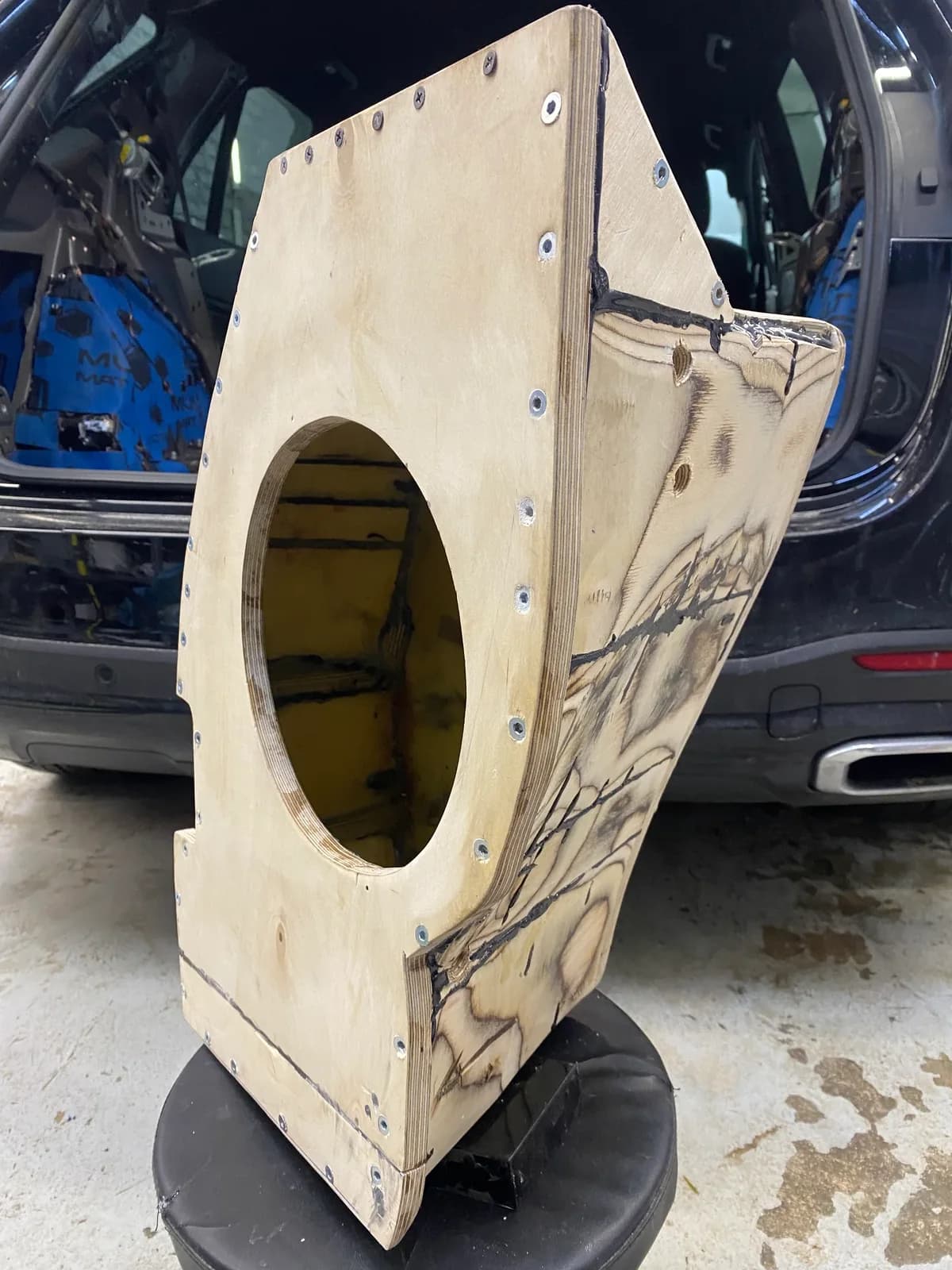
Before installing, check magnet and window clearance, polarity and a stable mounting surface. Air leakage around the basket can weaken low frequencies. Preparing the mount and seal is a separate job; it does not automatically mean full door soundproofing or a guaranteed increase in bass.
Which step should come first?
This matrix helps frame the decision, but cannot replace checking the actual vehicle. A symptom can have several possible causes.
| Situation | What to check first | What not to assume |
|---|---|---|
| You dislike the sound at moderate volume | A compatible speaker set and installation quality | That any replacement will play louder |
| The swap reduces volume or bass | Load, sensitivity, polarity, filters and the mounting seal | That a bigger amplifier is immediately necessary |
| Distortion appears as volume rises | The driver, signal and amplification limits | That new speakers will remove source clipping |
| The goal is strong, deep bass | A plan for a subwoofer, space and suitable amplification | That a door speaker can replace any subwoofer |
Why are the new speakers quieter? Can an amplifier come later?
Lower sensitivity, a different load, incorrect wiring or factory processing are things to investigate. Compare the same recording, source and settings; the volume knob position alone is not a measure of quality. If you hear crackling or lose a channel, start with diagnosis rather than boosting the equalizer.
An additional amplifier can be considered as a later stage if speaker compatibility, signal access and filtering are planned ahead. Keeping the head unit and adding DSP are separate decisions. Outline the intended final system before the first purchase, so each component is chosen in context.
Checklist before choosing speakers in Warsaw
Gather these details to discuss the upgrade. You do not need to dismantle the doors or measure head unit outputs yourself.
- Vehicle model, year, factory audio package and any known separate factory amplifier.
- One main goal and your usual listening level; list faults separately.
- To confirm during selection: load, channel bandwidth, sensitivity with units and the set’s filters.
- To check during installation: depth, window, grille, adapter, connectors, polarity and mounting seal.
- Proposal scope: speakers, fitting parts, door preparation, operation checks and a plan for later stages.
How should you check an upgrade with the factory radio retained?
Compare a familiar recording at a similar listening level. Check left and right channels, calls, navigation prompts and vehicle alerts separately. Changes in load or sensitivity may affect those sounds too.
Do not compensate for a new problem with maximum bass boost. Record the symptom and return to mounting and electrical compatibility checks.
- The window travels fully without touching the magnet or wiring.
- Trim fits without bulging and the grille does not touch the cone.
- There are no channel dropouts, new crackles or overheating smells.
Questions and answers
Is a 165 mm diameter enough for selection?
No. Check the cut-out, depth, adapter, crossover space and window travel. Similar catalogue dimensions do not guarantee installation without modifications.
Does a higher RMS rating draw more power from the radio?
No. A speaker power-handling rating is not a demand for constant power. Load and output depend on impedance and signal, among other factors; a “100 W” label does not establish compatibility.
Can the factory tweeter stay?
Only after assessing the complete crossover arrangement and levels. Adding a kit’s tweeter beside an active OEM tweeter may change load and response. Do not casually wire them in parallel.
Planning new speakers while keeping the factory stereo?
Describe your audio package and what you want to change. Review the service scope and prepare the details needed to discuss the first stage.