
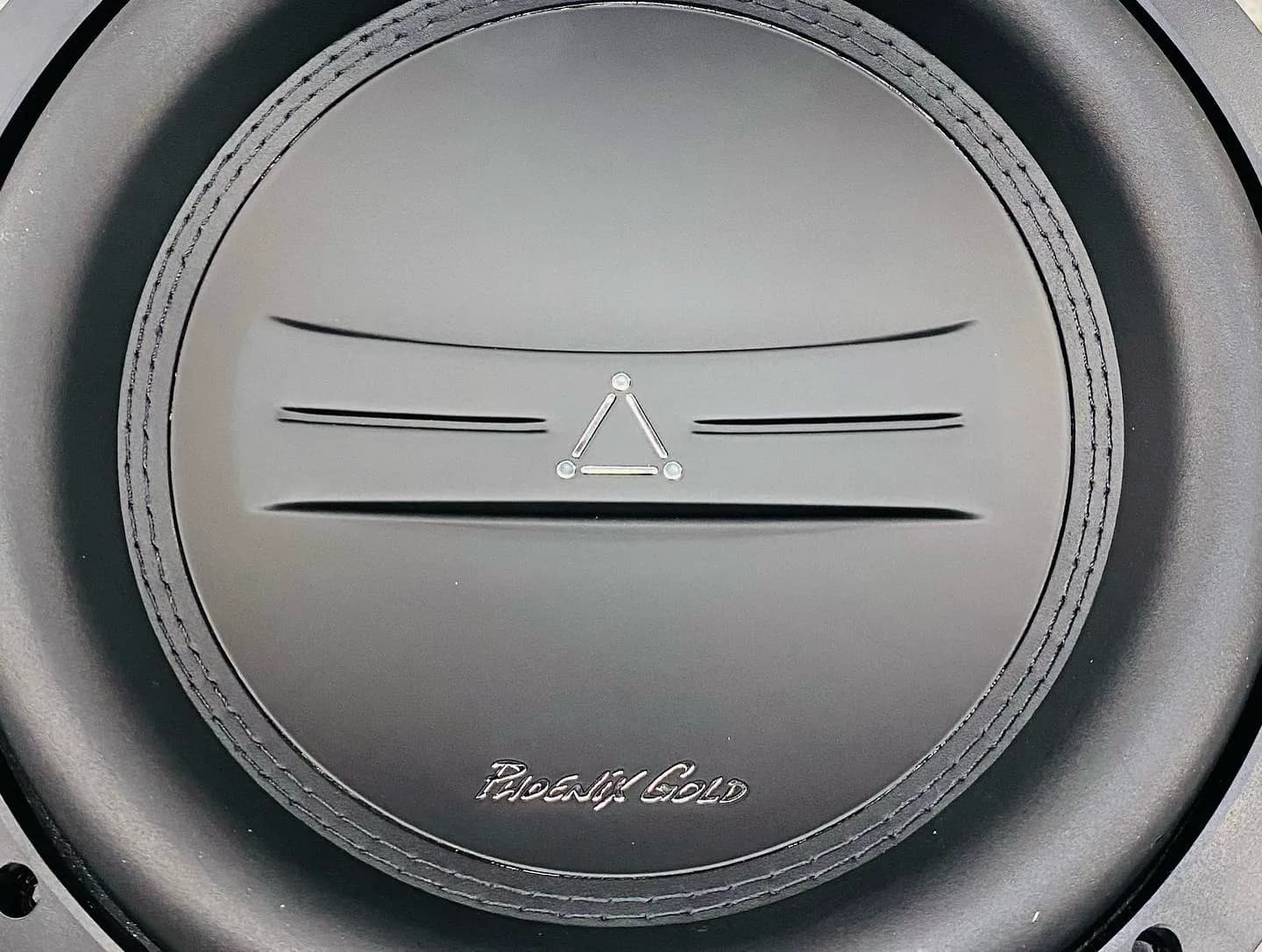
A subwoofer can be added to many factory systems without replacing the radio when a suitable signal and compatible integration route are available. An active unit includes an amplifier; a passive one needs a separate power channel. No RCA output need not prevent an upgrade, but high-level inputs or an appropriate interface must be checked. Location, enclosure and tuning matter as much as the driver.
When is a subwoofer the right first step?
If vocals and midrange are clear but music lacks a low-frequency foundation, a dedicated bass driver may complement the system. If doors rattle or bass weakened after a speaker swap, check mounting, polarity and the signal first. A subwoofer cannot repair those causes.
Listen while parked without maximum bass boost. Decide whether you want a gentle addition at everyday volume or substantial deep-bass headroom. Those goals lead to different enclosures and amplifiers.
Active or passive subwoofer?
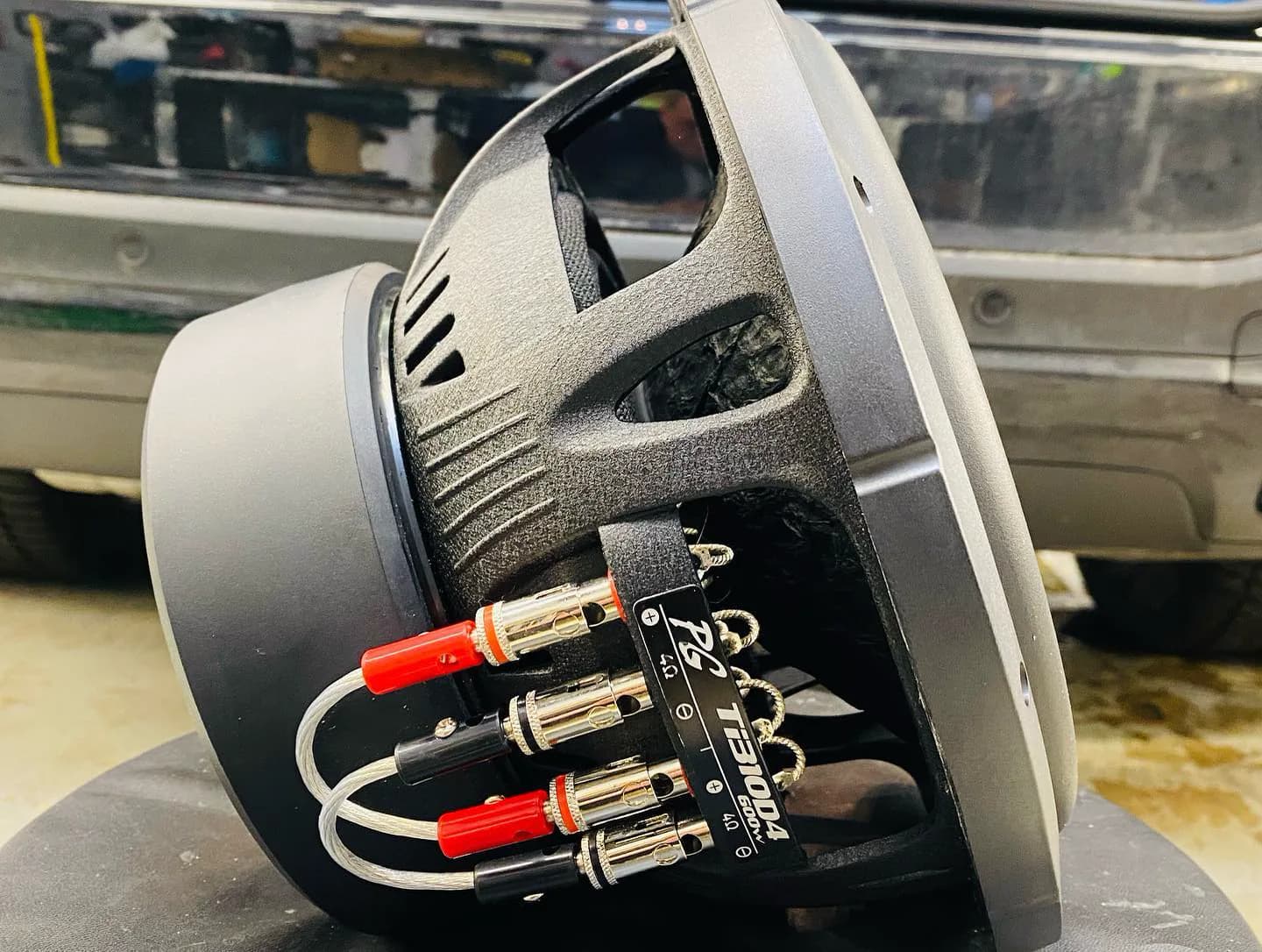
An active unit combines driver, enclosure and amplifier. It still needs suitable power, signal and mounting. A passive driver needs a compatible amplifier and an enclosure selected to its documentation; it cannot be casually substituted for a door speaker.
“Active” does not automatically mean “under-seat”, and “passive” does not imply a large box. Both have different formats. Assess actual dimensions, bandwidth and installation options rather than maximum watts alone.
| Solution | What you select | When to consider it | Limit |
|---|---|---|---|
| Compact active unit | Complete unit, inputs, dimensions and power supply | Space is the priority | Less freedom to change enclosure and amplification |
| Enclosed passive driver + amplifier | Driver, enclosure, load and power channel | You want to tailor location and bass headroom | More elements to integrate |
Under the seat, in a side cavity or in the boot?
Under-seat fit involves more than height. Check clearance through full seat travel and adjustment, connector space and separation from vents, wiring and mechanisms. The HELIX U 8A/U 10A manual requires secure mounting and clearance from other parts. This illustrates criteria rather than recommending that product for every vehicle.
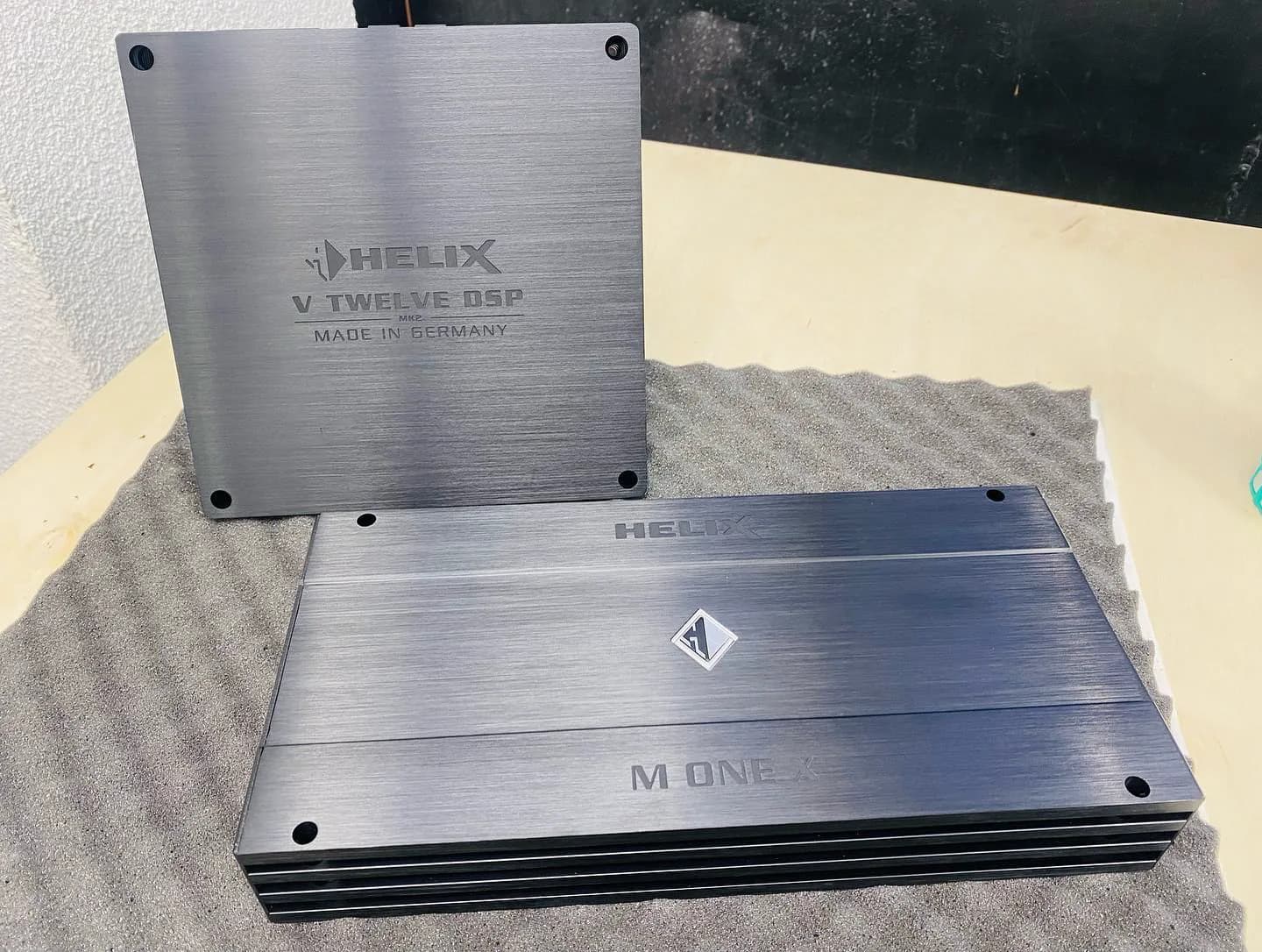
Do not expect identical bass from every position. Body construction, enclosure and integration with the front speakers change the result. Photos show real equipment from the studio archive, not a universal package.
| Location | Check before choosing | Trade-off |
|---|---|---|
| Under the seat | Seat travel, vents, wiring and cooling | Limited enclosure space |
| Side cavity | Enclosure volume, service access and mounting | Vehicle-body-specific fit |
| Boot enclosure | Cargo, securing the box and spare-wheel or repair-kit access | Boot space used |
What if the radio has no RCA output?
High-level inputs accept a suitable speaker signal; a converter or interface may adapt another signal path to the amplifier. However, not every connection point has the required bandwidth. A factory channel may be filtered or its equalisation may change with volume.
Check the source, permitted input voltage, turn-on method and behaviour after locking the car. A high-level input does not establish compatibility with every factory amplifier. Do not casually join speaker outputs; any required summing needs suitable equipment.
Why do gain, crossover and phase matter?
Gain matches input sensitivity; it does not create additional amplifier power. A low-pass filter (LPF) limits higher frequencies sent to the subwoofer; phase and delay affect integration with the front speakers. No single set of knob positions suits every car.
Adding a subwoofer does not automatically relieve the door speakers. Reducing their deepest bass requires an appropriate high-pass filter (HPF) and a system that supports applying it. Tuning should assess the combined response rather than bass output alone.
What belongs in the quote and collection checks?
A quote should identify the unit or driver–enclosure–amplifier combination, integration, a correctly protected power supply, mounting and configuration. A device fuse does not automatically replace power-cable protection. Ratings and locations follow equipment instructions and vehicle design.
There is no separate fixed subwoofer-installation price stated here. The PLN 4,000 audio-project starting price is not a tariff for every subwoofer job. Prepare radio photos, audio details and space limits to compare the complete scope.
- Check a familiar track at several normal levels without distortion.
- Assess integration with vocals and front midbass rather than vibration alone.
- Check calls, navigation, vehicle alerts and bass-level control if agreed.
- Check mounting, cargo access and full seat movement.
- Agree checks of turn-on, turn-off and vehicle sleep behaviour.
Questions and answers
Will a subwoofer work with every factory radio?
This cannot be confirmed without checking the signal and integration route. Missing RCA outputs can sometimes be addressed, but filtered channels, digital paths and output levels require suitable equipment.
Can a small under-seat subwoofer replace a large enclosure?
Do not assume equivalent deep-bass extension and output headroom. A compact unit saves space but has enclosure and driver limits. Choose by your goal and a verified configuration rather than maximum power alone.
Must the front speakers be replaced too?
Not always. Healthy, correctly installed speakers may stay when they suit the goal. Levels and filters still need integration and their limits need checking; a subwoofer cannot fix faults or door rattles.
Plan bass before buying equipment
Give the model, year, audio version and space you can allocate. We can agree the signal path, amplification and installation scope in Warsaw.