
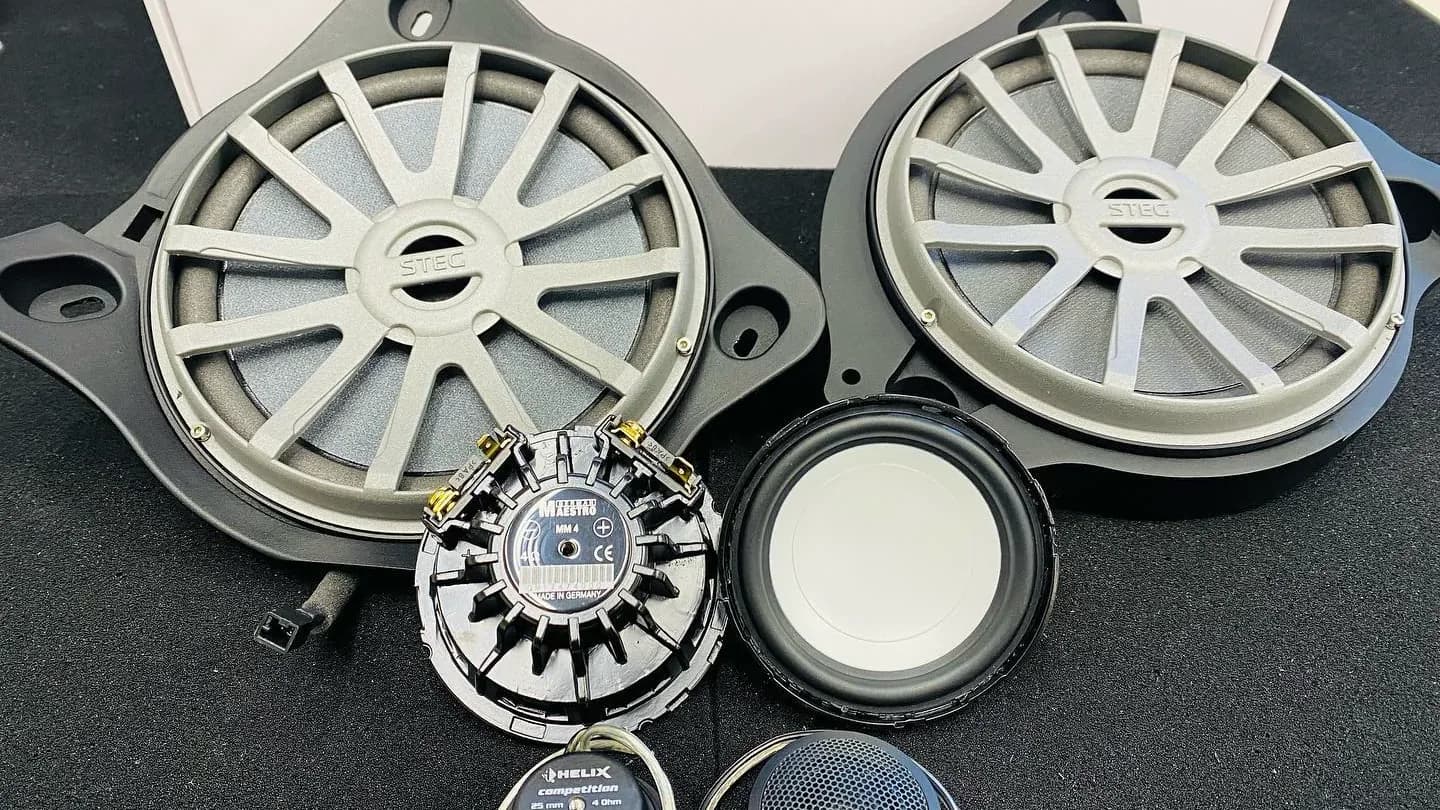
Consider component speakers when your car has separate woofer and tweeter locations, or you intend to create suitable mounting positions. Coaxials can simplify replacement where there is one speaker location per side. Neither design guarantees better sound in every car. Before buying, check dimensions, the available signal and permitted load. For components, also decide how the frequency bands will be divided: passively or actively.
What do speaker layout and the number of ways mean?
A two-way coaxial speaker combines a woofer and tweeter in one assembly. The woofer handles the lower part of the range and the tweeter handles high frequencies. In a two-way component set, they are mounted separately. The number of ways describes the frequency split, rather than the number of amplifier channels.
A separate tweeter lets you choose a location away from the bottom of the door. That gives scope to shape the soundstage, rather than an automatic improvement: aim, grille obstruction and integration with the woofer matter. A three-way component set adds a midrange driver. It needs space and suitable filtering, so it is not a straightforward replacement for a two-way set.
Compare installation, filters and amplifier channels
This table describes a conventional left-and-right two-way stereo set. It does not cover every OEM system or bi-amping arrangement. Count channels for rear speakers, a centre speaker and a subwoofer separately.
| Arrangement | Mounting and frequency split | Power channels for the front | When to consider it |
|---|---|---|---|
| Coaxial | One assembly per side; tweeter filter included | 2 | One mounting location and no plan for separate tweeters |
| Passive component | Separate drivers; matched crossover after the amplifier | 2 — one per side | Space for tweeters and filters; no need to adjust every driver independently |
| Active component | Separate drivers and wiring; frequency split before power amplification | 4 — one per driver | Independent driver adjustment, with configuration and tuning planned |
What should you check in the factory locations?
Check the cut-out, depth behind the speaker and space in front of it under the grille. Allow clearance for the window and regulator, as well as a protruding coaxial tweeter. A 165 mm label alone does not establish fit. HELIX lists a mounting depth of 61 mm for the PF K165.2 woofer and 58 mm for the PF C165.2 coaxial. Those are dimensions of specific models, rather than a rule for either design.
If there is already a tweeter near the mirror, establish what happens to it when the woofer is replaced by a coaxial. Do not leave an extra tweeter operating by accident: the high-frequency sources will change, and the wiring arrangement may change the load. Check whether the factory woofer wire carries the full frequency range or only part of it. A coaxial cannot reproduce treble that is absent from its input signal.
Plan rigid mounting, sealing and a filter location protected from water. New wiring must not obstruct mechanisms. A separate tweeter does not necessarily mean rebuilding the pillars: a suitable mount in the factory position may be enough, subject to checking the particular car.
Do components need a DSP and a separate amplifier?
The component layout alone does not require them. A suitable passive set can use the head unit's power amplifier or another compatible amplifier. Its crossover divides the frequency range between drivers. That crossover is not always one large box: HELIX PURE F uses a two-part Flex-Crossover. Plan for every filter section according to its instructions, rather than looking only for room for a single module.
In an active arrangement, filtering happens before power amplification and each driver has its own power channel. A DSP or suitable active crossover can perform the split; a DSP label does not mean the device is already configured. Set the tweeter high-pass filter to suit its documentation before playback. Do not copy a crossover frequency from an unrelated set or bypass the passive network without a prepared configuration.
Front and rear: how do you allocate four channels?
A conditional planning example: you have four compatible power channels, the required signal and a two-way front set. You could allocate two channels to a passive front and two to rear speakers. With an active front, all four serve the front woofers and tweeters. The rear then needs additional compatible amplification or a separate retained OEM path after integration checks. A subwoofer is not included. This is a channel count, rather than a wiring plan for a particular installation.
You do not have to replace the rear speakers with the front ones. If you mainly listen from the driver's seat and the rear speakers work properly, you can assess the first stage without changing them. If you regularly carry passengers, their listening experience is a separate criterion. Check the front-to-rear balance at your usual volume. In a multichannel system, or one carrying vehicle sounds, do not disconnect channels without establishing their functions.
What should you prepare for selection and handover in Warsaw?
Record the model, year, sound system version, existing speaker locations and who usually listens. The scope should specify the chosen layout, filters, wiring, mounts and tuning. Product documentation establishes its requirements, rather than compatibility with every car.
The Mercedes GLE 350D project shows door speakers and concealed amplifiers. You can view the mounting approach, but its photographs are not a universal selection plan. Assess your own set after the interior is reassembled and all the functions you use have been checked.
- Before buying: establish full dimensions, load, available frequency range and channel count.
- Before installation: agree what happens to factory tweeters, where filters go and how later expansion would work.
- At handover: check both sides, vocals on a familiar recording, rear-seat sound, window operation and trim.
Questions and answers
Can I combine a woofer and tweeter from different brands?
A designed system can do that, but matching diameter or impedance does not establish compatibility with a crossover. Driver responses, levels and the frequency split matter. If you want to retain one component, provide its exact model; do not treat an arbitrary crossover from another set as a ready-made solution.
Can a coaxial speaker work with a DSP amplifier?
Yes, if it matches the output and configuration. You can adjust the channel feeding the whole speaker, but a coaxial with one input does not let you set separate woofer and tweeter delays. Its built-in filter still divides their frequency bands. A DSP does not automatically turn it into an active component set.
Will choosing components instead of coaxials give deeper bass?
A separate tweeter alone does not determine the woofer's bass capability. Assess the driver, door mounting, signal and amplification. If you want the lowest bass, also compare adding a subwoofer rather than expecting that change solely from a different speaker layout.
Plan a set around your car's mounting locations
Prepare the sound system version, photographs of accessible grilles and your upgrade goal. The service page form creates a description to copy or download; it does not send a message itself.