
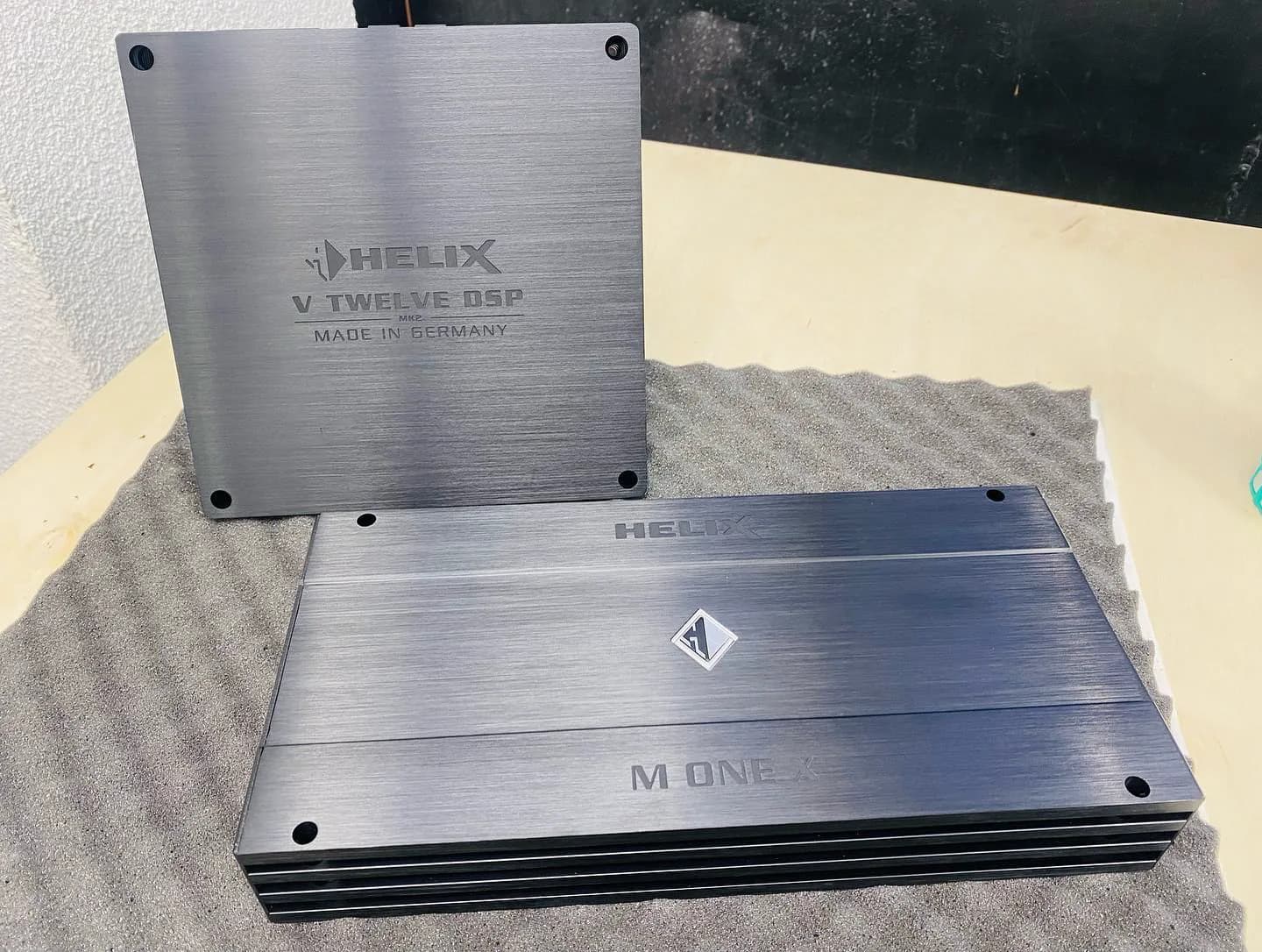
A factory premium sound system can often be upgraded while retaining the original head unit and screen. First identify the exact system version, how audio is transmitted and which functions the factory amplifier handles. It may remain as the signal source or be replaced by a compatible interface and a new audio chain. A Burmester, Harman Kardon or Bose badge alone confirms neither kit compatibility nor retention of every function.
Why does a premium badge not identify the wiring?
The same product name can appear across different models and generations of infotainment. Connectors, channel counts, frequency splits and controls may differ. Production date and previous modifications also matter. The model year and a grille photograph are starting points, rather than a complete specification.
Count speakers, amplifier channels and the inputs needed to receive the signal separately. They are different numbers: the MATCH PP-MB 1.9BUR harness documentation describes a particular Burmester version with 13 speakers as a nine-channel system. It also specifies the corresponding amplifier and input expansion. This illustrates compatibility conditions; it is not a kit for every Mercedes.
What information should you gather before choosing equipment?
Prepare the details in the left column. The installer completes the right side after checking the car and documentation. If a label is behind trim, do not dismantle the car just to photograph it. Missing details can be established during an inspection.
| What the owner provides | What needs confirmation |
|---|---|
| Model, production date and equipment version | Audio option code and documentation matching this car |
| Menu photograph and infotainment name | Head unit generation and protocol used to communicate with the amplifier |
| System name and modification history | Amplifier part number, connectors and extra modules, such as RAM in a BMW |
| What is missing in the sound, and at what volume | Available frequency bands and signal levels at the proposed outputs |
| Which speakers should stay | Load, filters and channel assignment for those speakers |
| Functions you want to retain | Paths for calls, navigation and vehicle sounds, with the necessary checks |
Three integration paths with the original head unit
Identify the signal take-off point before selecting a device. High-level means a signal from speaker outputs; the new device must accept its level. A digital OEM connection requires support for the correct protocol. An optical SPDIF input on a processor is not itself a MOST input.
| Signal path | When to consider it | What to establish before buying |
|---|---|---|
| Head unit → factory amplifier → high-level → DSP and new amplification | When suitable OEM outputs provide the required signal | Frequency bands, levels, processing and input count; functions still handled by the OEM unit |
| Head unit / data bus → compatible interface → DSP and amplification | When an interface exists for the exact system version | Protocol, configuration, volume control, turn-on behaviour and functions lost |
| Factory audio chain → matched replacement speakers | When the problem and specifications allow the electronics to stay | Load, channel bandwidth and mounting; what this stage will not change |
Will a digital interface retain surround and fader?
A digital connection alone does not establish that. For example, the HELIX SDMI25 converts a compatible MOST25 signal into optical stereo SPDIF. Its manual excludes multichannel Dolby/DTS surround formats; the German Optical Out section also excludes fader information, meaning front-to-rear adjustment. These are limitations of that interface, rather than of all digital solutions.
List music, calls, navigation, parking sounds and warnings, balance, fader and spatial modes separately. For each function, agree what remains, what behaves differently and what the new audio chain will not support. A button still appearing in the menu does not prove that it will behave identically after the upgrade.
When will replacing speakers alone not solve the problem?
If a channel lacks the required frequency range, or the signal is already distorted earlier in the chain, a new speaker will not remove the cause. This does not mean that every premium system needs all its electronics replaced. Check the signal and matching rather than buying a package by brand name alone.
If only the deepest bass is missing, consider a separate subwoofer path after checking the signal. If one channel suddenly falls silent or starts crackling, diagnose the fault first. Final tuning belongs after the connections and operation of all selected channels have been verified.
What does the Burmester project show, and what should you check at handover?
In the documented Street Sound Studio project, the factory Burmester 3D components in a Mercedes were replaced with a new set. The photographs show speakers, HELIX amplifiers and a subwoofer. The account does not identify the complete infotainment version or interface, so it is not a wiring plan for another car. A separate GLE 350D project shows concealed amplifier locations and speaker mounting.
Before an upgrade in Warsaw, record which components stay, where the signal is taken, which functions must work and which limitations you accept. Return to that list at handover. Check music from your usual sources, a phone call, announcements and operation after switching the car off and restarting it. Assess retained functions separately from sound quality.
Questions and answers
Will replacing the amplifier remove the factory audio menu?
The menu may remain on screen even though some adjustments no longer control the new audio chain. Ask how each item works: equaliser, fader, spatial modes and announcement volume. Check them before the work and at handover; the appearance of the menu alone does not establish that its functions have been retained.
Can an extra Bluetooth source replace integration with the car?
It can feed music directly into the new audio chain, but does not replace the paths for calls, navigation and vehicle sounds. Source priority, switching and volume control still need to be established. An additional source is a listening option, rather than evidence that OEM integration has been resolved.
Does a plug & play adapter let me restore the factory system?
A suitable harness can simplify removal, but reversibility depends on the entire job: mounting, wiring, software changes and keeping the original parts. Agree exactly what can be restored and which steps that would require. The words plug & play do not describe every part of the installation.
Prepare the details of your premium sound system
Record your car version, sound system, main concern and functions to retain. The service page form prepares a description to copy or download; it does not send a message itself.